25+ Ways to Explore Math With a Hundreds Chart
A hundreds chart is one of those wonderfully simple math tools that can be used again and again.
It can help children practice counting and number recognition, but that’s just the beginning. A hundreds chart can also help children explore patterns, place value, addition, subtraction, multiplication, and mathematical thinking.
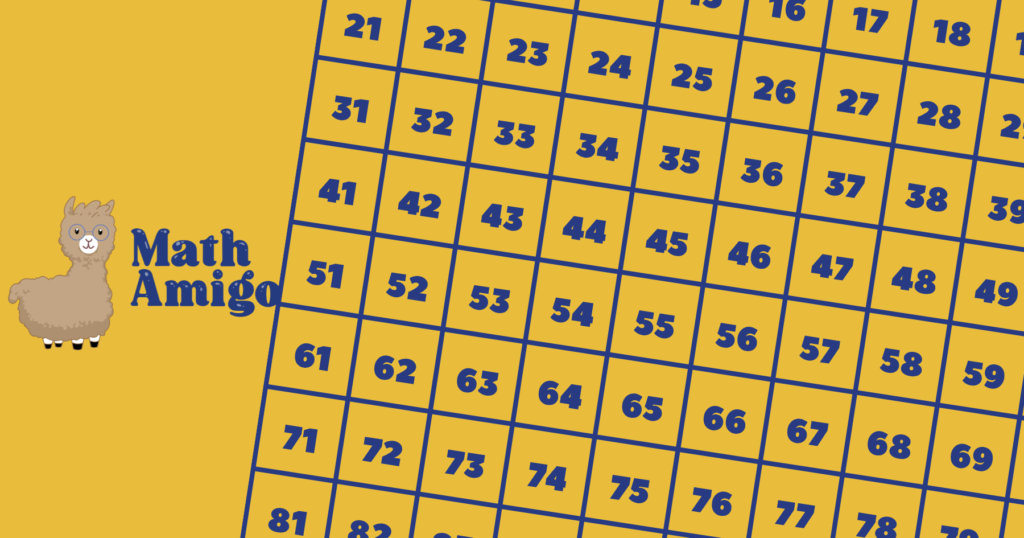
So grab your Math Amigo hundreds chart and let’s play with some numbers!
Make Your Hundreds Chart Reusable
Before you get started, here’s a little teacher trick that makes your hundreds chart even more useful.
Print your chart and slip it into a plastic page protector. Your child can then use a dry-erase marker to circle, color, write, and mark numbers right on the chart. When you’re finished, simply wipe it clean and use it again!
You can also print your chart on cardstock or colored paper to make it a little sturdier.
Once you’ve made your reusable chart, you’re ready to explore.
Teacher tip: Keep your hundreds chart somewhere easy to reach. You don’t need to plan an entire math lesson around it. Pull it out for five minutes, explore a pattern, play a quick game, or investigate a number.
🔢 Start With the Basics
1. Find a Number
Call out a number and have your child find it as quickly as possible.
Then switch roles. Let your child choose a number for you to find.
For younger children, this is a simple way to practice number recognition. For older children, make it more challenging by giving clues instead of saying the number.
2. One More, One Less
Choose a number and ask:
-
What is one more?
-
What is one less?
Have your child point to each number on the chart.
Then ask, “How did you know?”
You’re helping your child connect the numbers they see with the idea of one more and one less.
3. Ten More, Ten Less
Choose a number and find the number that is 10 more.
Then find the number that is 10 less.
Ask your child what they notice about where those numbers are located on the chart.
This is a great way to help children see the connection between place value and movement on the chart.
4. Count Forward and Backward
Start anywhere on the chart and count forward.
Now try counting backward.
Can your child start at 63 and count backward to 48?
For an extra challenge, ask them to start at a number other than a multiple of 10. This helps children become more flexible with their counting rather than simply reciting a memorized sequence.
👀 Look for Patterns
This is where a hundreds chart gets really interesting.
5. Color the Even Numbers
Have your child color every even number.
Then ask:
“What do you notice?”
Don’t worry about giving them the answer. Let them look for the pattern themselves.
6. Find the Multiples of 5
Circle or color all the multiples of 5.
What pattern do you see in the ones digit?
Can you predict what the next multiple of 5 will be without counting through every number?
7. Find the Multiples of 10
Color 10, 20, 30, 40, and so on.
Ask your child what they notice about the location of these numbers.
Then ask:
“Why do you think they line up this way?”
8. Follow a Pattern
Start at 3 and add 3 each time:
3 → 6 → 9 → 12 → 15…
Have your child mark each number.
Then try it again with 4, 6, 7, or 9.
Ask your child to describe the pattern they see.
9. What Do You Notice?
Choose a number and look at the numbers directly above, below, to the left, and to the right.
Ask:
“What do you notice?”
Don’t immediately explain the pattern. Give your child time to discover it.
You might be surprised by what they see.
🎲 Turn It Into a Game
10. Mystery Number
Give your child clues about a secret number.
For example:
I’m thinking of a number between 30 and 50.
It’s even.
It’s 10 more than 27.
Can your child find it?
Then let your child make the clues for you.
11. Race to 100
Take turns choosing a number and moving forward by a set amount.
For younger children, use simple addition. For older children, try skip-counting or multiplication.
You can make this cooperative instead of competitive, too. Can you work together to reach 100 using the rules you’ve chosen?
12. Closest to 50
Each player chooses a number.
Who can get closest to 50?
Try different target numbers, too.
For an extra challenge, have each player explain how they know which number is closer.
13. Number Detective
Choose a secret number and give clues one at a time.
My number is greater than 40.
It is less than 70.
It is a multiple of 5.
It is even.
Can your child figure it out?
Then let your child create a mystery number for you.
14. Cover It!
Choose several numbers and cover them with small objects such as coins, buttons, or LEGO pieces.
Can your child figure out which numbers are hidden?
For an extra challenge, cover several numbers in a row and ask your child to predict which numbers are underneath.
➕ Addition and Subtraction
A hundreds chart can make addition and subtraction more visual.
15. Add 1
Start with a number and move one place to the right.
What happened to the number?
Try several examples and ask your child what they notice.
16. Add 10
Start with a number and move down one row.
What happened?
Ask your child to predict where they’ll land before they move.
17. Subtract 1
Start with a number and move one place to the left.
What happened?
Again, ask your child to make a prediction first.
18. Subtract 10
Start with a number and move up one row.
Once your child understands these movements, give them a problem such as:
34 + 20
Instead of immediately reaching for pencil and paper, ask:
“Can you show me that on the hundreds chart?”
Then try problems that require more than one move.
For example:
34 + 23
How could you use the chart to solve it?
✖️ Multiplication and Skip-Counting
A hundreds chart can also help children visualize multiplication patterns.
19. Skip-Count by 2s
Mark:
2, 4, 6, 8, 10…
What pattern do you see?
Can you predict where the next number will be?
20. Skip-Count by 3s
Try:
3, 6, 9, 12, 15…
Then look at the pattern your markings create.
21. Skip-Count by 4s, 6s, 7s, or 8s
Choose a number and mark its multiples.
Then ask:
“What patterns do you notice?”
Try different numbers and compare the patterns.
22. Multiplication Detective
Pick a multiplication fact.
For example:
6 × 4
Ask your child to find 24 on the chart.
Then ask:
“How could the chart help you figure out why 6 × 4 = 24?”
The goal isn’t simply to find 24. Encourage your child to explain the relationship between the multiplication fact and the numbers on the chart.
🧠 For Older or More Advanced Learners
Don’t put the hundreds chart away just because your child knows how to count to 100.
There is still plenty to investigate!
23. Prime or Composite?
Choose numbers and determine whether they are prime or composite.
Use the chart to look for patterns among the multiples.
24. Find the Factors
Choose a number such as 36.
How many different multiplication facts can you find that make 36?
Can you find all of its factor pairs?
25. Perfect Squares
Find:
1, 4, 9, 16, 25, 36, 49, 64, 81, 100
What do you notice about their locations?
Can you explain why these numbers appear where they do?
26. Divisibility Detective
Choose a number and investigate whether it is divisible by 2, 3, 5, or 10.
Can your child find patterns that help them predict the answer?
For an extra challenge, ask:
“Can you find a number that is divisible by both 3 and 5? What do you notice about it?”
❤️ One of My Favorite Ways to Use a Hundreds Chart
Don’t give your child an activity at all.
Just give them the chart and ask:
“What do you notice?”
Then wait.
Let them look.
Let them point.
Let them make a prediction.
Let them be wrong.
Let them discover something.
You might be surprised by what they see.
That’s one of the things I love about simple math tools. They give children something concrete to explore rather than simply another page of problems to complete.
And there’s something important happening when you let your child investigate this way. You’re giving them the opportunity to notice relationships, make predictions, test ideas, and explain their thinking.
Those are mathematical skills, too.
Math doesn’t always have to look like a lesson.
Sometimes, you just need a chart, a marker, and a good question.
Keep Exploring!
Your hundreds chart can become a regular part of your math time.
Try one activity today, put the chart away, and pull it out again another day.
You don’t have to do all 26 activities. In fact, you shouldn’t!
Choose the ones that fit your child’s age, interests, and current math skills. Let curiosity lead the way.
And remember, the best math question isn’t always “What’s the answer?”
Sometimes it’s simply:
“What do you notice?”
📥 Have Your Math Amigo Hundreds Chart?
If you’re reading this because you scanned the QR code on your Math Amigo hundreds chart, welcome!
Now you have 26 ways to use that simple chart. You don’t need to try them all. Pick one that looks interesting, grab a dry-erase marker, and spend a few minutes exploring with your child.
If you haven’t downloaded your own copy yet, you can get the free Math Amigo Hundreds Chart here:
[Get your free hundreds chart]
And if you come up with your own hundreds chart game, I’d love to hear about it!